Saturday, April 28, 2012

Support

Have you ever sung in a choir, and had the director yell at you: "Support that tone!" and wondered what on earth they were going on about? Well, I'm going to try and make it a little less clear. (Yup, that's what I said.)

In earlier posts, I've spoken about the importance of stance and breathing. Support is related to both of these. You're going to have a very difficult time supporting a tone without good posture or breath control, but there is much more to it than that.


This is Sarah Brightman singing Henry Mancini's Moon River. There is SO much wrong with this that I almost don't know where to start. I could mention the stupid crowny-thing in her hair, or ask why her pants are see-through, or even wonder if she's working her abs sitting on the huge ball. But, instead, I'm going to talk about her complete and total lack of focus, breath control and support. 

Let's start with the breath control. She cannot sustain any phrasing at all. I happen to have sheet music for Moon River. (It's from when the movie Breakfast at Tiffany's came out. Cost a whopping $1.25, if you're interested.) She holds out nothing longer than 1 1/2 measures. Nothing. 5 notes is the longest phrase. And these don't make sense in the context of the song. It is simply that she cannot hold out anything longer. She's letting out huge amounts of air with each and every single note. You can hear the air escaping in the breathy quality of her voice. 

Focus. There is none. That can be heard, once again, in the air rushing out, the breathiness to her voice. The tones aren't clear, they are cloudy with all the air. The lack of focus can also be heard in the constant scooping.  She doesn't have the air for longer phrases, and this makes some of the notes a little bit more difficult to reach. To make up for that, she scoops. (Yes, I know. Scooping can be a stylistic thing, but should still be used sparingly. Not every other note! That's just sloppy.)

Support. Its very difficult to support anything sitting on a giant ball with your legs stuck out in front of you like that. (In some cultures, it is considered rude to show people the soles of your feet, even your shoes. Apparently, she's never heard that, as she's showing the soles of her boots to a multitude of people.) When singers think about support, we usually think of just the abdominal muscles. We pooch out the tummy, forcing the diaphragm to flatten. And, viola! support! (On a craft show on PBS, I recently  heard the host pronounce that vie-la. Just for the record - it is vwah-la. Don't complain to me - it's French.) Actually, there is a lot more to it than just the abdominal muscles, although they are vitally important to the process. 

Also involved are, the thigh muscles, inner thigh muscles and the gluteus maximus (Butt cheeks). All of these muscles need to be engaged. What do I mean by this? Check out this video. It's a coach showing how to free throw in basketball. He has a young volunteer demonstrating what he's talking about.
  Throughout this video, you can see the kid getting ready to make the shot. All of his muscles are ready, time and time again, to throw the ball, if only the plump coach would shut up and let him do it! Every muscle in his young body is ready. That's what a singer's muscles should feel like. Engaged, energized and ready for anything. Without that, it's difficult to support the tone properly. (Poor kid, he almost looks like he's performing the 'potty dance')

Another Sarah Brightman example. I found this and went there expecting another train wreck. And I was not disappointed. She has no idea what the lyrics are about. (Glancing at the lyrics, I'm not sure I know, but I'm not the one who chose to sing the song. Here's what Wikipedia had to say on the subject :The author of Procol Harum: beyond the pale, Claes Johansen, suggests that the song "deals in metaphorical form with a male/female relationship which after some negotiation ends in a sexual act." This is supported by Tim de Lisle in Lives of the Great Songs, who remarks that the lyrics concern a drunken seduction, which is described through references to sex as a form of travel, usually nautical, using mythical and literary journeys. And I am NOT going to talk about Chaucer's Miller's Tale!)
 
Pay close attention at 1:21. I'll wait while you make it to that point in the video. Her voice is breathy, unfocused, unsupported. Then when she's ready for the high note, on "was" her knees visibly push straight, and suddenly, her voice has power and clarity! (That's why she likes sheer skirts! Just for these teaching points! How thoughtful.) 


Now, for contrast, here's John Barrowman singing Moon River. (Yes, Cap't Jack Harkness can sing!) He has very good focus. And just listen to those clear tones! And the phrasing is beautiful. Those notes are all supported. (And I think he's better looking than Ms Brightman, too! And no stupid crowny-thing!)


I had planned on giving you Procul Harem singing A Whiter Shade of Pale.  But, they don't sing anywhere near as good as Mr. Barrowman, so if you want to hear them, you'll have to go to Youtube yourself. So there.


Next week?

Saturday, April 14, 2012

How many voices do I have?


Each of us has at least 3 separate voices. And I'm not talking about the voices in your head, or the voices that tell you to not have that extra serving of lasagna. I'm talking about singing voices. But even calling them voices can be misleading. Some teachers prefer the term "registers." It all depends on who you talk to and who they studied with, and which side of the bed they got out of this morning. Which all boils down to: "It's complicated."

So what exactly am I talking about? Listen to "What's Up" by "4 Not-Blondes."

 Do you hear how full and rich her voice is   through most of the song? But then, at 1:01,  1:05, 1:15, 1:20 (I'm seeing a pattern) hear what happens. Do you hear how it almost sounds like someone else singing? (I love her hats, they are so cool!)

 She starts out singing in her chest voice. We call it that because it feels like it is resonating in the chest. But then, for just a note or two, it almost sounds like a little girl singing. She's gone into her head voice, so called because it feels like it's resonating in the head. Between the two extremes is the middle voice. It tends to feel like it's in your throat, where you would think that we want the voice to always be, but you'd be wrong. 

Some more examples of the different qualities of the voices:

Jewel yodeling (you don't need to watch more than a few seconds, unless you're a glutton for punishment).  Why am I making you listen to yodeling? Let me refer you to Wikipedia again: Yodeling,yodelling,jodeling) is a form of singing that involves singing an extended note which rapidly and repeatedly changes in pitch from the vocal or chest register(or "chest voice") to the head register; making a high-low-high-low sound. The English wordyodel is derived from a German word jodeln(originally Austro-Bavarian language) meaning "to utter the syllablejo" (pronounced "yo" in English). This vocal technique is used in many cultures throughout the world. (And I am not the only person to not be enthralled with the art form. Sir Walter Scott wrote in his June 4, 1830 journal entry that "Anne wants me to go hear the Tyrolese Minstrels but...I cannot but think their yodeling...is a variation upon the tones of a jackass.


 Cranberries - Zombie:  first at 1:20 on the first syllable of "Fighting" (Gold dress does nothing for her, but I love the chain wig! - it's probably wrong to critique fashion on a really very serious song…)

 This abrupt switch from chest to head voices is what gives yodeling its characteristic sound, it an important part of Celtic music (hence the Cranberries song - plus, my husband loves that one). It's also a part of the music of many other cultures. Since much of my training has been to bridge the expanses of my voice seamlessly, I find the obvious differences in tone annoying. And, since classical Western training endeavors to do that, we will assume that you want to do the same, and not sound like any of these examples.

The chest voice has some admirable qualities. As you can hear in 4 Non-Blondes, it has volume and richness. The head voice has lightness and an almost angelic sound. (Are you tired of videos yet? Hopefully not, because here's one more: the Von Trapp Children singing.  In Carol of the Bells - the first song, everything is sung in lovely, pure head tones. You can hear hints of the breathy quality to their amplified voices. They are light, angelic: it really is lovely. Then, at 1:33, as they are beginning Doe, a deer, (I kid you not - they sing Doe, a deer!) the soloist gives us our first hint of chest voice. She is also the oldest looking of the 4. But it is a lovely young voice, smooth from the bottom all the way to the top. You can hear the richness of her voice, and it sounds far less breathy than the others'.

So, the trick is to keep the richness of the chest, while also keeping the ringing, angelic quality of the head. The first step is often to find all of those voices in you. Just about everyone manages to find their mid-range. Many untrained singers find the chest voice pretty easily. The head range is often the tricky one. (Although many young sopranos are frightened of what they think of as the rough qualities of the chest. Each voice is different. Not good or bad, just different.)

Then it becomes a matter of learning where each and every single note should fall: in your voice and in each and every single song. How much depth to carry up from the chest into the highest notes, and how much of the ringing head tones to carry down into the lowest, deepest notes you are capable of. And this will differ in each song, every day. It can be affected by how much sleep you got the night before, the pollen count, the relative humidity, you name it, it can probably affect your voice. (Does that sound mind-bogglingly difficult? With practice, it becomes so automatic that you don't even think about it.)

There is a diagram that gets used a lot. I call it the hourglass. If we put the head voice at the top of the diagram and the chest voice at the bottom, you have a visual of what we're trying to accomplish. Without this concept, you end up with what is called a break in the voice, when you just cannot carry up anymore weight or carry down anymore of the lightness.

My mother had an analogy that always made sense to me. (Sorry - but it went with a story) When she was a student teacher, they went on a field trip from her school in Louisville, KY, to New York City. (Quite the field trip - right?) She went shopping in Saks 5th Avenue, and bought everyone back home a gift. Paperweights. About 2 dozen of them. 
(Maybe like this)
After shopping, they all went to the Empire State Building, where they found that the elevators were out of order, and they had to walk up all the stairs: all 1860 of them. It wasn't long before she was wishing she hadn't gotten all those paperweights. She was wishing that she could leave a trail of paperweights on the stairs, kind of like Hansel & Gretel leaving a trail of breadcrumbs, waiting for her to pick up again on her way back down. Sometimes I still think about leaving paperweights behind when I'm trying to lighten up my voice for a particular passage.

Have you gotten the idea that this is not necessarily easy? Good. Can it be fun? Yes! Should you go it alone? No. You can really do some damage to yourself, depending on your age, experience and health. For example: I never do much with the chest when I'm working with kids before they hit puberty. Their voices, just like their bodies, are undergoing so many changes that it's just not a good idea to push either end of the voice (chest or head). Do I teach kids before puberty? Yes. I'm just very careful of what we do. But, this is still just a part of why I liken vocal training to an adventure.

Next week: Support!

Saturday, March 31, 2012

Good Mental Concept

I've often said that one of the jobs of a voice teacher is to learn how our students think. Sometimes, what a word means to me, and what it means to my student are very different things. I've had to learn how to present vocal ideas to a man who suffered 70% hearing loss as a child. I've had to learn how to speak so that a dancer can comprehend vocal imagery. I've had to learn how to follow a young woman who grew up speaking Mandarin Chinese. Sometimes I wish I could read minds; it would make the job so much easier.

Studying in Germany, I met a lot of singers; professional, successful, struggling, amateurs, you name it. I remember one day a tenor was coming in for his lesson as I was leaving. He was walking with a limp, and apologized for  even being there, since he knew he wasn't going to be able to sing that day. Our teacher, Mike Rhodes, asked him what was wrong, since there was no hint of hoarseness in his speaking voice. No, no, it wasn't his voice. He'd hurt his right foot, and so, couldn't sing. Asked what that had to do with singing, he replied that he sang with his right foot. I suggested that perhaps he could try singing with his left. And, while that made our teacher laugh, the tenor did not appreciate the comment.


Mike had an open studio. This meant that his students were allowed, even encouraged, to sit in on one another's lessons. You can learn a lot from someone else's problems. I was sitting in on a tenor's lesson. (Why is it always tenors?) He was really struggling with one note in an aria. Not a verse, not a phrase. One note.  It was a high note. As I recall, it was a B, just a half-step below the infamous high-C. This particular note needed to be very soft, and hang effortlessly in the air. 


Or that was the idea. After 20 minutes of struggling with this effortless note, the poor tenor was just about ready to give up. Either that or throw our teacher and his piano out the window. I felt for both of them. Mike had tried just about every technique he could think of to pull this note out of this tenor. And the tenor was failing, in front of an audience - me. Finally, in desperation, the man volunteered to try one last thing. He didn't care if it worked or not, they were going to finish the aria this time. I still remember how that note sounded: it was so soft, it hung on the air, as if it had always been there, just waiting for this man to pluck it out. It was effortless, it was beautiful. He finished the aria, and asked if that had been right. Reassured that it had been, he turned to Mike, and demanded: "Why didn't you just tell me it was a green note?"

These two stories have a couple of things in common. They both took place in the studio of my teacher in Germany, they both involve tenors, and most important for the moment: they both involve mental concept. 


Unless the singer knows where the note should be in their voice, and unless they know how it should sound, they are merely rolling the dice in the crap shoot of vocal production. A pianist has it easy. I can go to any piano in the world, and find middle-C. And provided that piano is in tune, it will always sound exactly the same. Voices are different. Middle-C may be out of reach for some basses, or bottoming out for some sopranos. And, to make things interesting, it will be in a slightly different place in your voice from one day to the next. All of this will depend on how much sleep you got, whether you had tea or coffee with your breakfast, what kind of green-growing-thing is currently blooming, and the relative humidity. All of this combines to make singing on pitch unbelievably complicated.


This can be dealt with simply by trial and error. And let me tell you, there's a lot of error! When I miss a note, the entire neighborhood knows about it! Fortunately, by this point, I don't miss that many. 


The singer also needs to know how much of the chest voice to carry up into each note, and how much of the head voice to carry down. This can not only change by day, but can be different in each song. Are you getting the feeling that this is a very difficult skill? 


Good. Because it is, and it needs to become automatic. Someone told me once that the number of computations that we accomplish each moment we are driving a car is literally mind-boggling:  speed, trajectories, Newton's laws, the list is almost endless. And, yet, we do it, day in, day out. The same for singing - except that hopefully, no one's life is endangered when we sing.


And on top of all that, there is the quality of the note: not just hitting it full out, but that elusive green note: the note that just hangs there, softly and effortlessly. And without a qualified teacher to tell you when you have found that note - to be your ears outside of your body - you can't be certain that you've found that quality.

Hmm. . . what shall I post about next week? Tune in and see!

Saturday, March 24, 2012

Proper Focus

Herr Weinsinger used to say that in order to really practice these elements, we needed to memorize them. And not just memorize for a test, but really know them. He wanted to be able to call us in the middle of the night, waking us out of a sound sleep, ask, "What are the 5 basic elements of singing?" and have each of us rattle them off in our sleep. He also felt that the elements that you had the most trouble remembering were the ones that needed the most work.There were those at the university who thought he was nuts, and he may have been, but that doesn't mean he wasn't right.

My posture was always pretty good. Relaxation of the vocal mechanism was a bear; in my early days, I was a very tense singer. Breathing was easy: I'm lucky in that I've always breathed properly. Proper focus, though, was always another bear.

This is also where the basic elements get more subjective. The first 3 are physical, and even though they can be very difficult, they are pretty much "cut-and-dried." You are either doing them right, or you're not. But proper focus is all caught up in how we think.

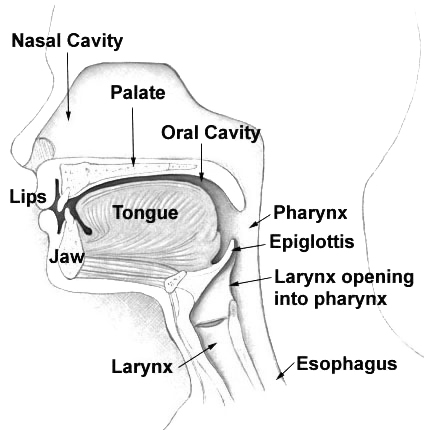
Let's start with this: your tone needs to be in the facial masque, or sinus cavities. This is also known as putting a spin in the voice. And how do we do this? I'm going to reuse a picture from my blog on Element 2. See the soft palate? That needs to raise. (To find out how to do this, go back to that blog. It's all there.)

By raising the soft palate, we can "place" the voice in the facial masque. At any rate, we think we can; it feels like we have. The problem is that the voice hasn't actually moved anywhere. What we're doing is changing the shape of our resonator. What's a resonator?

* sigh *

I was afraid you'd ask that. Are you ready? A resonator may be defined as a secondary vibrator which is set into motion by the main vibrator and which adds its own characteristics to the generated sound waves." (I stole that from the Wikipedia article Vocal Resonation. Whoever said that singers were stupid? Oh yeah: I said that. Oops!) What that means for us is this: our main vibrators are the vocal cords, which set in motion our secondary vibrator, the nasal cavity.

This is where having a qualified teacher becomes vital. A teacher provides ears outside of your own body to tell you when you have achieved the right sound. Internally, it can actually sound like there is a grating, raspy edge to the voice. But, externally, it sounds full, and gives the voice the ringing quality that we want in the voiceIt helps the voice carry over longer distances, and even over orchestras. While this often seems like it's giving the voice more volume, I think it also raises the frequencies the voice produces. You get another story.

Not terribly long ago, I was a music director for several services at the Kirtland Air Force Base Chapel. While I was there, a brand new sound board was installed. I didn't really have much to do with it, but I was expected to begin to use the microphones that dotted the raised altar area. I tried to explain to the chaplains that no one wanted me near a mic. They ignored me, and reminded me to work with the sound guys on the settings for me. I tried to explain to the sound guys. They told me that Britney Spears couldn't blow out the sound board, and so I didn't need to worry.

Britney Spears.

Really. I wish I was making that up.

The following Sunday, I stood at the podium to sing the Psalm for the Catholic Mass. I promise, I wasn't singing loudly. Aware of the microphone a foot away from my mouth, I was singing very softly. But, my voice is properly focused. After the first verse, the mic went dead. And then there was a very loud popping sound. I noticed the sound man in the balcony motioning me to go on.

I could tell that my mic was dead, so I sang a little louder to finish the Psalm. I found out later that I had over-powered my microphone, and caused a cascade that red-lined every mic up there, including the lapel-mics attached to the chaplain's shirt. I hadn't done that with volume, but with frequency.

We call this focus because it can feel like you are focusing the voice behind your cheeks. Sometimes it also helps to visualize a cone projecting from your mouth, coming to a point somewhere in front of you. The farther you want your voice to project, the longer your cone needs to be.

Often, for the beginning singer, the voice will come into focus on one note in one song. The trick is to keep that feeling for longer than the one note. This can take months. You work, and work, and struggle, and fight, and one day, it happens. And it's easy, and it's fun, and feels really good. That's usually when it's right. (You knew there had to be a reason for all this work, right? When it's right, it is so much fun!)

The second point in Proper Focus tells us that on high notes, the focus becomes even tighter, as is put right on the bridge of the nose. The focus moves from the facial masque, even more forward and up. Dramatic soprano Eileen Farrell once likened hitting a high-C to feeling like she was going to throw up. It's possible she was referring to how open the throat needs to be. Hopefully, she wasn't throwing up on the bridge of her nose, 'cause that would have been gross.

Like I said before, it's all how you think.

Next time: Good Mental Concept

Saturday, March 17, 2012

Proper Breathing: Part Deux


Here's the second part in the history-making two-part post on proper breathing. We stopped with the story about the idiot radiologist. We now get to pick up the subject of proper breathing with the concept of settling the breath. This is a rather subtle concept. And just to give you something to listen to, here's Frankie's version of Fly me to the Moon. There's nothing interesting going on visually, so you can listen and keep reading.

Here's what often happens when a singer takes a breath at the beginning of Fly Me to the Moon. The introduction is playing. Just before his first note, the singer takes a carefully timed breath, mindful to expand the lower ribs in a barrel-like fashion. He is nervous, and the audience knows it. His pulse is racing. The first word is "Fly." On that first note, all the jealously hoarded air rushes out like kindergarteners kept inside for too long on a sunny day, and the singer wonders why he has no air for the rest of the phrase.

This poor breathless singer has fallen victim to one of the classic blunders - the most famous of which is "never get involved in a land war in Asia" - but only slightly less well-known is this: "settle the breath before singing."

A different singer comes to the front. She, too, is going to sing Fly Me to the Moon. The introduction is playing. At the beginning of the last measure, the singer takes a carefully timed breath, mindful to expand the ribs in a barrel-like fashion. Unlike the first singer, she has given enough time for the breath to settle. Her fears are put to rout. As they watch, the audience knows, even before she has sung her first note, that this singer will be good. She sings a long phrase; "Fly me to the moon and let me play among the stars, let me see what spring is like on Jupiter and Mars" before she takes another deep breath.

The main difference between our two hypothetical singers is that one has allowed the breath to settle and the other has not. Letting your breath settle is different from holding your breath. Holding the breath has tension, and keeps respiration from happening. Letting the breath settle is much gentler than that. It takes just a brief moment. But in that moment, many things have happened.

When you are nervous, your respiration speeds up and becomes shallow. That makes your heart race, feeding the nervousness, making the breath even more shallow. It becomes is never-ending cycle. When, however, you allow the breath to settle, it breaks that cycle, hopefully before it's really had time to start, and calms you down.

Letting the breath settle is also a way for you to tell your body that you are now in control of this automatic bodily function. Once again, you must trick your body into doing something that it might not want to do. You need to be firm with it, or it won't listen.

And, by taking that moment, it also tells the audience that you have something worth listening to. Combined with good posture, it gives you a commanding stage presence. Many people think that I'm much taller than I really am, simply based on how I stand and breathe on stage.

This brings me to the final sub-point in Proper Breathing: Breaths should not be great gasps for air, but controlled intake as well as controlled outflow. You should be a miser with your breath, making each molecule work for you. Herr Weinsinger used to tell us to imagine we'd just eaten a pastrami sandwich with extra garlic and onions, with an order of sauerkraut on the side. (I will admit, this sounds horrible to me, but that's part of the point) You don't want to breathe this stinky breath on anyone else, and so you keep as much breath inside as you possibly can. Suddenly, you are being a miser with your air.

This woman gets a little scary on the topic of breathing, but that doesn't mean that she isn't right. Who knew breathing was THIS important?


Saturday, March 10, 2012

Element 3: Proper Breathing


Everybody breathes. You've been doing it your entire life, how can you need to learn how to breathe?

The sad truth is that very few people breathe properly. Yeah, I know, how stupid does that sound? But, it's true. Most people breathe very shallowly, using only the top part of their lungs, when they should be breathing from their diaphragms and utilizing much more of the lungs' capacity.

Once again the first sub-point is: (drum roll, please!) Good Posture! How you stand matters!

I'm going to keep harping on this. Get used to it.

The second point is: Take small breaths, down low, expanding the lower ribs in a barrel-like fashion. (This is called "breathing from the diaphragm." Take notes; there'll be a test later.)

Let's take a moment to look at what happens when we breathe.


The diaphragm is an oddly-spelled muscle that has a dome-shape, and hangs out underneath the lungs, keeping them from falling into the stomach, colon and some of the other stuff down there.

(I'm serious - which idiot spelled it D I A P H R A G M? It's pronounced dye a fram, not dye a fragum - English can be stupid.)

When you need to breathe, the brain sends a signal down to the diaphragm, and it flattens. When this happens, suddenly there is more room for the lungs, and they expand to fill it. Air rushes in. You don't need to suck it in, or gasp, or really do anything but flatten your diaphragm. Ah, but there's the rub: how do we do that? I can fill in for my brain and tell my diaphragm to flatten. But does it listen to me? No - it's a diaphragm, it doesn't need to listen to anybody. Once again, we have the problem of not being able to see the item we're working with. "And," you may ask, "how can we possibly get it to flatten if we can't see it and it won't listen when we talk?" We trick it. (Remember? We started tricking our bodies last week. There will be more.)

You can trick it by pooching out your stomach. When you do that, the diaphragm is forced to flatten.

Now, I know, if you pooch out your stomach, you're going to look fat. We are constantly told to suck our tummies in. And that's the problem. If your tummy is always sucked in, then you simply cannot breathe properly. Look at runners. They are breathing from the diaphragm. Check out this video: this is a man talking to runners, not singers; but the technique is the same. He even talks about posture!


One of the many ways to experience abdonimal breathing, is to lie down on the floor, flat on your back. Place a hand on your stomach. Relax, and just breathe. With any luck at all, you’ll feel your abdomen rise and fall as you breath in and out.

While this has so far talked about the frontal part of proper breathing, Herr Weinsinger did stress the "barrel-like fashion" part. Because, as you might have noticed in the first video, the ribs should expand all around. I have students put their hands on my lower back, to either side of my spine, and feel the expansion when I breathe. The easiest way to feel this for yourself is to stand up and bend forward at the waist. Place your hands on your back, roughly where your kidneys hopefully are. While you are in that position, inhale; you should feel the expansion for yourself.

(Do it now. I can wait.)

Once when he was being interviewed, Placido Domingo was asked what he felt was the most difficult thing about singing. With no hesitation, he responded, "Breathing properly." (Of course, he said it with a strong Spanish accent.)

(I'm going to pretend that all of you know who Placido Domingo is. If you don’t: take the time to look him up on Wikipedia or YouTube.)

With this in mind, I’m going to spend two posts talking about breathing.

I do have a story for you. Since I have been singing since I was a baby, I have been very lucky in that I have always breathed from my diaphragm. (Yes, even when I was a teenager and didn’t want to look fat.) This has had many benefits for me as a singer. And I have medical proof of how much this can increase your lung function.

I was in my mid-20’s, and had a horrible upper respiratory infection. I couldn't talk, couldn't sing, could barely breathe without setting off a coughing fit. The doctor wanted to rule out pneumonia. So he ordered a chest x-ray. The tech lined me up with the markings on the wall, and told me to take a deep breath. I knew exactly how much air I could take before the coughing fit would start. So I carefully inhaled as much as I was able to, feeling my rib cage expand to roughly half of what it usually could.

Pictures taken, my husband and I were told to wait while the radiologist looked over the x-rays. After a little while, the doctor came out, and asked how long I had had asthma. I immediately panicked, imagining scar tissue on my lungs. But I really could not do more than croak. So Bill calmed me down, and asked the doctor why he thought I had asthma.

The man held up my ex-ray, and pointed out that my lungs were hyper-extended; apparently, a clear sign of asthma. It is also the sign of someone who routinely uses more of their lung capacity. Bill tried to explain to the man that I am a classically trained singer, who has always breathed from the diaphragm. The ignorant sack of snot looked down his nose at me (25 years ago, I was 50 pounds lighter - keep this firmly in mind) and said:”We occasionally see this type of lung usage in long-distance runners, which your wife is obviously not. She has asthma.” And he turned and walked off.

What that man was seeing was the full utilization of my lung capacity. The result of proper breathing.

Next week: Proper Breathing, Part 2

Saturday, February 25, 2012

Element 2: Relaxation of the Vocal Mechanism


"So," I can hear you ask, "just what does that mean?" Simply put, it means - relax your throat. But there is a lot more to it than that. Of course, you knew that, didn't you? If it was so simple, I wouldn't need to write about it and many voice teachers would go out of business. In fact, just like "Good Posture", it's harder than it looks.

Let me give you an analogy. When you play a piano, is the piano actually doing anything? Where is the work happening? The work is in the fingers of the person playing the instrument. Your larynx (voice box) is really doing very little. The bulk of the work is in other parts of your anatomy. (But that's for another show.)

Which brings me to the first point: Good Posture. Quick review (although there's nothing stopping you from going to last week's blog. I'll wait.)

(Oh, you're back, that was fast.) Good posture means standing with your feet shoulder-width apart, bottom tucked under, head straight with your chin slightly tucked under, and your ribcage lifted. (Pay attention: this is in the test.)

Going down the list, that brings us to: Throat and neck relaxed. Have you ever seen someone singing, and you could see the muscles in their neck are standing out like steel cables? Whenever I see someone like that, I gives me a sore throat. Because it's completely wrong!


If you look at her throat, you can see the muscles standing out. (Yes, I know this is Diana Ross, and I know that she is world-famous. I love her. That doesn't mean she does everything right. Very few of us do.)Think back to the piano analogy. If the instrument is doing the work, in this case the throat, then something is wrong with the technique.

This brings us to: Jaw loose (submissive look). Herr Weinsinger also called this the "village idiot look." Think "Duh," something any village idiot could say.

I have a friend (I have more than one, but he's the only one in this story) who was told by his teacher to imagine that he was holding a wine cork between his teeth. Kind of like this, if the child had any teeth (I love this picture!)


Once he was used to this, he was then told to practice holding the wine cork between his teeth the other way, up-and-down, shall we say. All in an effort to relax and loosen up the jaw.

Now, I am aware that there exists TMJ, which I thought stood for Tight Mouth and Jaw. Turns out that it stands for: Temporomandibular joint disorder, which, roughly translated, means you have a tight jaw. There's a lot more to it than that (and I should know, because I have it), so let's take a break while I read up on it at Wikipedia.

(OK, break over. Where was I? Right, relaxing the jaw!)

Most people think their jaw is relaxed and that they are opening wide. Most of us are so self-conscious that when we think our jaw is gaping wide, it's barely open. (Possibly one of the most difficult lessons to learn in vocal training is how to get over yourself. Don't feel bad, I had the same problem.) Just look at the maw on this woman! This is what I mean by opening your mouth wide. This is wonderful!
(And, yes, I know that I have used Diana Ross as a good and a bad example in the same blog. Voice training is just that complicated.)

Now we get to the really complicated part: Back of Throat (soft palate) lifted as in a yawn. First we need to establish just what the soft palate is. If you lift your tongue to the back of your teeth, and slide it just a little ways back, you can feel the hard palate. If you continue to slide your tongue along the roof of your mouth, until you feel the roof go soft: you will have found your soft palate.
In order for the voice to gain in range and volume, and to acquire the ringing tone that is so desirable to Western ears, the soft palate must be raised. But how to we do that? I can tell it to raise up all I want, but it just doesn't listen to me.

Well, we have to trick it. (We'll be doing a lot of tricking our bodies to do things in the coming weeks.) And we trick it by yawning. Give it a try right now. (It's not that you find this blog boring; I won't get my feelings hurt.) Pay attention to what is going on at the back of your throat as you yawn. Can you feel the soft palate raise up? If you exercise your soft palate by yawning with your mouth closed, you'll soon be able to raise the soft palate without yawning. This is an exercise that you can do waiting in line at the grocery, or while your watching TV, pretty much anytime. I know it sounds silly, but it really is essential to good singing.

Are you starting to get the idea that there's a lot more to singing than you'd ever thought? It really is far more complicated than most people imagine. But, when it all starts to come together and become automatic, it is the most glorious feeling in the world. And, yes, with enough practice, all of this and much more, becomes so automatic that you can actually begin to think about the music and not the mechanics of singing.

Next week: Proper Breathing