Herr Weinsinger used to say that in order to really practice these elements, we needed to memorize them. And not just memorize for a test, but really know them. He wanted to be able to call us in the middle of the night, waking us out of a sound sleep, ask, "What are the 5 basic elements of singing?" and have each of us rattle them off in our sleep. He also felt that the elements that you had the most trouble remembering were the ones that needed the most work.There were those at the university who thought he was nuts, and he may have been, but that doesn't mean he wasn't right.
My posture was always pretty good. Relaxation of the vocal mechanism was a bear; in my early days, I was a very tense singer. Breathing was easy: I'm lucky in that I've always breathed properly. Proper focus, though, was always another bear.
This is also where the basic elements get more subjective. The first 3 are physical, and even though they can be very difficult, they are pretty much "cut-and-dried." You are either doing them right, or you're not. But proper focus is all caught up in how we think.

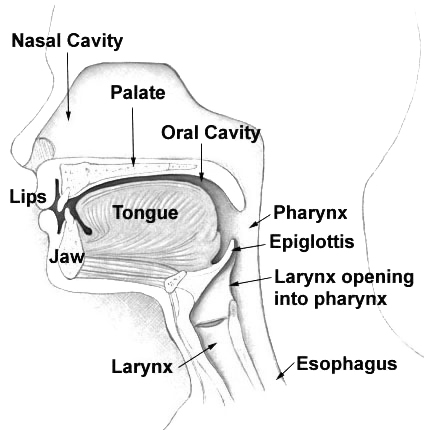
Let's start with this: your tone needs to be in the facial masque, or sinus cavities. This is also known as putting a spin in the voice. And how do we do this? I'm going to reuse a picture from my blog on Element 2. See the soft palate? That needs to raise. (To find out how to do this, go back to that blog. It's all there.)
By raising the soft palate, we can "place" the voice in the facial masque. At any rate, we think we can; it feels like we have. The problem is that the voice hasn't actually moved anywhere. What we're doing is changing the shape of our resonator. What's a resonator?
* sigh *
I was afraid you'd ask that. Are you ready? A resonator may be defined as a secondary vibrator which is set into motion by the main vibrator and which adds its own characteristics to the generated sound waves." (I stole that from the Wikipedia article Vocal Resonation. Whoever said that singers were stupid? Oh yeah: I said that. Oops!) What that means for us is this: our main vibrators are the vocal cords, which set in motion our secondary vibrator, the nasal cavity.

This is where having a qualified teacher becomes vital. A teacher provides ears outside of your own body to tell you when you have achieved the right sound. Internally, it can actually sound like there is a grating, raspy edge to the voice. But, externally, it sounds full, and gives the voice the ringing quality that we want in the voiceIt helps the voice carry over longer distances, and even over orchestras. While this often seems like it's giving the voice more volume, I think it also raises the frequencies the voice produces. You get another story.
Not terribly long ago, I was a music director for several services at the Kirtland Air Force Base Chapel. While I was there, a brand new sound board was installed. I didn't really have much to do with it, but I was expected to begin to use the microphones that dotted the raised altar area. I tried to explain to the chaplains that no one wanted me near a mic. They ignored me, and reminded me to work with the sound guys on the settings for me. I tried to explain to the sound guys. They told me that Britney Spears couldn't blow out the sound board, and so I didn't need to worry.
Britney Spears.
Really. I wish I was making that up.
The following Sunday, I stood at the podium to sing the Psalm for the Catholic Mass. I promise, I wasn't singing loudly. Aware of the microphone a foot away from my mouth, I was singing very softly. But, my voice is properly focused. After the first verse, the mic went dead. And then there was a very loud popping sound. I noticed the sound man in the balcony motioning me to go on.
I could tell that my mic was dead, so I sang a little louder to finish the Psalm. I found out later that I had over-powered my microphone, and caused a cascade that red-lined every mic up there, including the lapel-mics attached to the chaplain's shirt. I hadn't done that with volume, but with frequency.
We call this focus because it can feel like you are focusing the voice behind your cheeks. Sometimes it also helps to visualize a cone projecting from your mouth, coming to a point somewhere in front of you. The farther you want your voice to project, the longer your cone needs to be.
Often, for the beginning singer, the voice will come into focus on one note in one song. The trick is to keep that feeling for longer than the one note. This can take months. You work, and work, and struggle, and fight, and one day, it happens. And it's easy, and it's fun, and feels really good. That's usually when it's right. (You knew there had to be a reason for all this work, right? When it's right, it is so much fun!)
The second point in Proper Focus tells us that on high notes, the focus becomes even tighter, as is put right on the bridge of the nose. The focus moves from the facial masque, even more forward and up. Dramatic soprano Eileen Farrell once likened hitting a high-C to feeling like she was going to throw up. It's possible she was referring to how open the throat needs to be. Hopefully, she wasn't throwing up on the bridge of her nose, 'cause that would have been gross.
Like I said before, it's all how you think.
Next time: Good Mental Concept
"So," I can hear you ask, "just what does that mean?" Simply put, it means - relax your throat. But there is a lot more to it than that. Of course, you knew that, didn't you? If it was so simple, I wouldn't need to write about it and many voice teachers would go out of business. In fact, just like "Good Posture", it's harder than it looks.
Let me give you an analogy. When you play a piano, is the piano actually doing anything? Where is the work happening? The work is in the fingers of the person playing the instrument. Your larynx (voice box) is really doing very little. The bulk of the work is in other parts of your anatomy. (But that's for another show.)
Which brings me to the first point: Good Posture. Quick review (although there's nothing stopping you from going to last week's blog. I'll wait.)
(Oh, you're back, that was fast.) Good posture means standing with your feet shoulder-width apart, bottom tucked under, head straight with your chin slightly tucked under, and your ribcage lifted. (Pay attention: this is in the test.)
Going down the list, that brings us to: Throat and neck relaxed. Have you ever seen someone singing, and you could see the muscles in their neck are standing out like steel cables? Whenever I see someone like that, I gives me a sore throat. Because it's completely wrong!

If you look at her throat, you can see the muscles standing out. (Yes, I know this is Diana Ross, and I know that she is world-famous. I love her. That doesn't mean she does everything right. Very few of us do.)Think back to the piano analogy. If the instrument is doing the work, in this case the throat, then something is wrong with the technique.
This brings us to: Jaw loose (submissive look). Herr Weinsinger also called this the "village idiot look." Think "Duh," something any village idiot could say.
I have a friend (I have more than one, but he's the only one in this story) who was told by his teacher to imagine that he was holding a wine cork between his teeth. Kind of like this, if the child had any teeth (I love this picture!)

Once he was used to this, he was then told to practice holding the wine cork between his teeth the other way, up-and-down, shall we say. All in an effort to relax and loosen up the jaw.
Now, I am aware that there exists TMJ, which I thought stood for Tight Mouth and Jaw. Turns out that it stands for: Temporomandibular joint disorder, which, roughly translated, means you have a tight jaw. There's a lot more to it than that (and I should know, because I have it), so let's take a break while I read up on it at Wikipedia.
(OK, break over. Where was I? Right, relaxing the jaw!)
Most people think their jaw is relaxed and that they are opening wide. Most of us are so self-conscious that when we think our jaw is gaping wide, it's barely open. (Possibly one of the most difficult lessons to learn in vocal training is how to get over yourself. Don't feel bad, I had the same problem.) Just look at the maw on this woman! This is what I mean by opening your mouth wide. This is wonderful!
(And, yes, I know that I have used Diana Ross as a good and a bad example in the same blog. Voice training is just that complicated.)
Now we get to the really complicated part: Back of Throat (soft palate) lifted as in a yawn. First we need to establish just what the soft palate is. If you lift your tongue to the back of your teeth, and slide it just a little ways back, you can feel the hard palate. If you continue to slide your tongue along the roof of your mouth, until you feel the roof go soft: you will have found your soft palate.
In order for the voice to gain in range and volume, and to acquire the ringing tone that is so desirable to Western ears, the soft palate must be raised. But how to we do that? I can tell it to raise up all I want, but it just doesn't listen to me.
Well, we have to trick it. (We'll be doing a lot of tricking our bodies to do things in the coming weeks.) And we trick it by yawning. Give it a try right now. (It's not that you find this blog boring; I won't get my feelings hurt.) Pay attention to what is going on at the back of your throat as you yawn. Can you feel the soft palate raise up? If you exercise your soft palate by yawning with your mouth closed, you'll soon be able to raise the soft palate without yawning. This is an exercise that you can do waiting in line at the grocery, or while your watching TV, pretty much anytime. I know it sounds silly, but it really is essential to good singing.
Are you starting to get the idea that there's a lot more to singing than you'd ever thought? It really is far more complicated than most people imagine. But, when it all starts to come together and become automatic, it is the most glorious feeling in the world. And, yes, with enough practice, all of this and much more, becomes so automatic that you can actually begin to think about the music and not the mechanics of singing.
Next week: Proper Breathing