Herr Weinsinger used to say that in order to really practice these elements, we needed to memorize them. And not just memorize for a test, but really know them. He wanted to be able to call us in the middle of the night, waking us out of a sound sleep, ask, "What are the 5 basic elements of singing?" and have each of us rattle them off in our sleep. He also felt that the elements that you had the most trouble remembering were the ones that needed the most work.There were those at the university who thought he was nuts, and he may have been, but that doesn't mean he wasn't right.
My posture was always pretty good. Relaxation of the vocal mechanism was a bear; in my early days, I was a very tense singer. Breathing was easy: I'm lucky in that I've always breathed properly. Proper focus, though, was always another bear.
This is also where the basic elements get more subjective. The first 3 are physical, and even though they can be very difficult, they are pretty much "cut-and-dried." You are either doing them right, or you're not. But proper focus is all caught up in how we think.
Let's start with this: your tone needs to be in the facial masque, or sinus cavities. This is also known as putting a spin in the voice. And how do we do this? I'm going to reuse a picture from my blog on Element 2. See the soft palate? That needs to raise. (To find out how to do this, go back to that blog. It's all there.)
By raising the soft palate, we can "place" the voice in the facial masque. At any rate, we think we can; it feels like we have. The problem is that the voice hasn't actually moved anywhere. What we're doing is changing the shape of our resonator. What's a resonator?
* sigh *
I was afraid you'd ask that. Are you ready? A resonator may be defined as a secondary vibrator which is set into motion by the main vibrator and which adds its own characteristics to the generated sound waves." (I stole that from the Wikipedia article Vocal Resonation. Whoever said that singers were stupid? Oh yeah: I said that. Oops!) What that means for us is this: our main vibrators are the vocal cords, which set in motion our secondary vibrator, the nasal cavity.
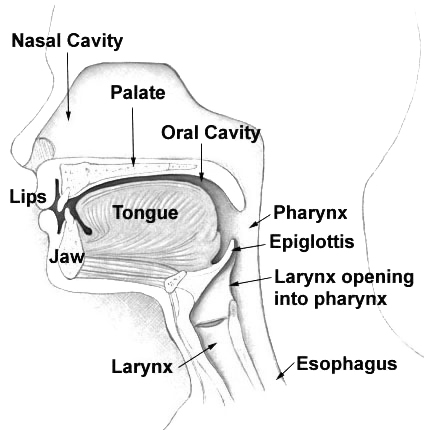
This is where having a qualified teacher becomes vital. A teacher provides ears outside of your own body to tell you when you have achieved the right sound. Internally, it can actually sound like there is a grating, raspy edge to the voice. But, externally, it sounds full, and gives the voice the ringing quality that we want in the voiceIt helps the voice carry over longer distances, and even over orchestras. While this often seems like it's giving the voice more volume, I think it also raises the frequencies the voice produces. You get another story.
Not terribly long ago, I was a music director for several services at the Kirtland Air Force Base Chapel. While I was there, a brand new sound board was installed. I didn't really have much to do with it, but I was expected to begin to use the microphones that dotted the raised altar area. I tried to explain to the chaplains that no one wanted me near a mic. They ignored me, and reminded me to work with the sound guys on the settings for me. I tried to explain to the sound guys. They told me that Britney Spears couldn't blow out the sound board, and so I didn't need to worry.
Britney Spears.
Really. I wish I was making that up.
The following Sunday, I stood at the podium to sing the Psalm for the Catholic Mass. I promise, I wasn't singing loudly. Aware of the microphone a foot away from my mouth, I was singing very softly. But, my voice is properly focused. After the first verse, the mic went dead. And then there was a very loud popping sound. I noticed the sound man in the balcony motioning me to go on.
I could tell that my mic was dead, so I sang a little louder to finish the Psalm. I found out later that I had over-powered my microphone, and caused a cascade that red-lined every mic up there, including the lapel-mics attached to the chaplain's shirt. I hadn't done that with volume, but with frequency.
We call this focus because it can feel like you are focusing the voice behind your cheeks. Sometimes it also helps to visualize a cone projecting from your mouth, coming to a point somewhere in front of you. The farther you want your voice to project, the longer your cone needs to be.
Often, for the beginning singer, the voice will come into focus on one note in one song. The trick is to keep that feeling for longer than the one note. This can take months. You work, and work, and struggle, and fight, and one day, it happens. And it's easy, and it's fun, and feels really good. That's usually when it's right. (You knew there had to be a reason for all this work, right? When it's right, it is so much fun!)
The second point in Proper Focus tells us that on high notes, the focus becomes even tighter, as is put right on the bridge of the nose. The focus moves from the facial masque, even more forward and up. Dramatic soprano Eileen Farrell once likened hitting a high-C to feeling like she was going to throw up. It's possible she was referring to how open the throat needs to be. Hopefully, she wasn't throwing up on the bridge of her nose, 'cause that would have been gross.
Like I said before, it's all how you think.
Next time: Good Mental Concept
Showing posts with label Herr Weinsinger. Show all posts
Saturday, March 24, 2012
Saturday, March 10, 2012
Element 3: Proper Breathing
Everybody breathes. You've been doing it your entire life, how can you need to learn how to breathe?
The sad truth is that very few people breathe properly. Yeah, I know, how stupid does that sound? But, it's true. Most people breathe very shallowly, using only the top part of their lungs, when they should be breathing from their diaphragms and utilizing much more of the lungs' capacity.
Once again the first sub-point is: (drum roll, please!) Good Posture! How you stand matters!
I'm going to keep harping on this. Get used to it.
The second point is: Take small breaths, down low, expanding the lower ribs in a barrel-like fashion. (This is called "breathing from the diaphragm." Take notes; there'll be a test later.)
Let's take a moment to look at what happens when we breathe.
The diaphragm is an oddly-spelled muscle that has a dome-shape, and hangs out underneath the lungs, keeping them from falling into the stomach, colon and some of the other stuff down there.
(I'm serious - which idiot spelled it D I A P H R A G M? It's pronounced dye a fram, not dye a fragum - English can be stupid.)
When you need to breathe, the brain sends a signal down to the diaphragm, and it flattens. When this happens, suddenly there is more room for the lungs, and they expand to fill it. Air rushes in. You don't need to suck it in, or gasp, or really do anything but flatten your diaphragm. Ah, but there's the rub: how do we do that? I can fill in for my brain and tell my diaphragm to flatten. But does it listen to me? No - it's a diaphragm, it doesn't need to listen to anybody. Once again, we have the problem of not being able to see the item we're working with. "And," you may ask, "how can we possibly get it to flatten if we can't see it and it won't listen when we talk?" We trick it. (Remember? We started tricking our bodies last week. There will be more.)
You can trick it by pooching out your stomach. When you do that, the diaphragm is forced to flatten.
Now, I know, if you pooch out your stomach, you're going to look fat. We are constantly told to suck our tummies in. And that's the problem. If your tummy is always sucked in, then you simply cannot breathe properly. Look at runners. They are breathing from the diaphragm. Check out this video: this is a man talking to runners, not singers; but the technique is the same. He even talks about posture!
One of the many ways to experience abdonimal breathing, is to lie down on the floor, flat on your back. Place a hand on your stomach. Relax, and just breathe. With any luck at all, you’ll feel your abdomen rise and fall as you breath in and out.
While this has so far talked about the frontal part of proper breathing, Herr Weinsinger did stress the "barrel-like fashion" part. Because, as you might have noticed in the first video, the ribs should expand all around. I have students put their hands on my lower back, to either side of my spine, and feel the expansion when I breathe. The easiest way to feel this for yourself is to stand up and bend forward at the waist. Place your hands on your back, roughly where your kidneys hopefully are. While you are in that position, inhale; you should feel the expansion for yourself.
(Do it now. I can wait.)
Once when he was being interviewed, Placido Domingo was asked what he felt was the most difficult thing about singing. With no hesitation, he responded, "Breathing properly." (Of course, he said it with a strong Spanish accent.)
(I'm going to pretend that all of you know who Placido Domingo is. If you don’t: take the time to look him up on Wikipedia or YouTube.)
With this in mind, I’m going to spend two posts talking about breathing.
I do have a story for you. Since I have been singing since I was a baby, I have been very lucky in that I have always breathed from my diaphragm. (Yes, even when I was a teenager and didn’t want to look fat.) This has had many benefits for me as a singer. And I have medical proof of how much this can increase your lung function.
I was in my mid-20’s, and had a horrible upper respiratory infection. I couldn't talk, couldn't sing, could barely breathe without setting off a coughing fit. The doctor wanted to rule out pneumonia. So he ordered a chest x-ray. The tech lined me up with the markings on the wall, and told me to take a deep breath. I knew exactly how much air I could take before the coughing fit would start. So I carefully inhaled as much as I was able to, feeling my rib cage expand to roughly half of what it usually could.
Pictures taken, my husband and I were told to wait while the radiologist looked over the x-rays. After a little while, the doctor came out, and asked how long I had had asthma. I immediately panicked, imagining scar tissue on my lungs. But I really could not do more than croak. So Bill calmed me down, and asked the doctor why he thought I had asthma.
The man held up my ex-ray, and pointed out that my lungs were hyper-extended; apparently, a clear sign of asthma. It is also the sign of someone who routinely uses more of their lung capacity. Bill tried to explain to the man that I am a classically trained singer, who has always breathed from the diaphragm. The ignorant sack of snot looked down his nose at me (25 years ago, I was 50 pounds lighter - keep this firmly in mind) and said:”We occasionally see this type of lung usage in long-distance runners, which your wife is obviously not. She has asthma.” And he turned and walked off.
What that man was seeing was the full utilization of my lung capacity. The result of proper breathing.
Next week: Proper Breathing, Part 2
The sad truth is that very few people breathe properly. Yeah, I know, how stupid does that sound? But, it's true. Most people breathe very shallowly, using only the top part of their lungs, when they should be breathing from their diaphragms and utilizing much more of the lungs' capacity.
Once again the first sub-point is: (drum roll, please!) Good Posture! How you stand matters!
I'm going to keep harping on this. Get used to it.
The second point is: Take small breaths, down low, expanding the lower ribs in a barrel-like fashion. (This is called "breathing from the diaphragm." Take notes; there'll be a test later.)
Let's take a moment to look at what happens when we breathe.
The diaphragm is an oddly-spelled muscle that has a dome-shape, and hangs out underneath the lungs, keeping them from falling into the stomach, colon and some of the other stuff down there.
(I'm serious - which idiot spelled it D I A P H R A G M? It's pronounced dye a fram, not dye a fragum - English can be stupid.)
When you need to breathe, the brain sends a signal down to the diaphragm, and it flattens. When this happens, suddenly there is more room for the lungs, and they expand to fill it. Air rushes in. You don't need to suck it in, or gasp, or really do anything but flatten your diaphragm. Ah, but there's the rub: how do we do that? I can fill in for my brain and tell my diaphragm to flatten. But does it listen to me? No - it's a diaphragm, it doesn't need to listen to anybody. Once again, we have the problem of not being able to see the item we're working with. "And," you may ask, "how can we possibly get it to flatten if we can't see it and it won't listen when we talk?" We trick it. (Remember? We started tricking our bodies last week. There will be more.)
You can trick it by pooching out your stomach. When you do that, the diaphragm is forced to flatten.
Now, I know, if you pooch out your stomach, you're going to look fat. We are constantly told to suck our tummies in. And that's the problem. If your tummy is always sucked in, then you simply cannot breathe properly. Look at runners. They are breathing from the diaphragm. Check out this video: this is a man talking to runners, not singers; but the technique is the same. He even talks about posture!
One of the many ways to experience abdonimal breathing, is to lie down on the floor, flat on your back. Place a hand on your stomach. Relax, and just breathe. With any luck at all, you’ll feel your abdomen rise and fall as you breath in and out.
While this has so far talked about the frontal part of proper breathing, Herr Weinsinger did stress the "barrel-like fashion" part. Because, as you might have noticed in the first video, the ribs should expand all around. I have students put their hands on my lower back, to either side of my spine, and feel the expansion when I breathe. The easiest way to feel this for yourself is to stand up and bend forward at the waist. Place your hands on your back, roughly where your kidneys hopefully are. While you are in that position, inhale; you should feel the expansion for yourself.
(Do it now. I can wait.)
Once when he was being interviewed, Placido Domingo was asked what he felt was the most difficult thing about singing. With no hesitation, he responded, "Breathing properly." (Of course, he said it with a strong Spanish accent.)
(I'm going to pretend that all of you know who Placido Domingo is. If you don’t: take the time to look him up on Wikipedia or YouTube.)
With this in mind, I’m going to spend two posts talking about breathing.
I do have a story for you. Since I have been singing since I was a baby, I have been very lucky in that I have always breathed from my diaphragm. (Yes, even when I was a teenager and didn’t want to look fat.) This has had many benefits for me as a singer. And I have medical proof of how much this can increase your lung function.
I was in my mid-20’s, and had a horrible upper respiratory infection. I couldn't talk, couldn't sing, could barely breathe without setting off a coughing fit. The doctor wanted to rule out pneumonia. So he ordered a chest x-ray. The tech lined me up with the markings on the wall, and told me to take a deep breath. I knew exactly how much air I could take before the coughing fit would start. So I carefully inhaled as much as I was able to, feeling my rib cage expand to roughly half of what it usually could.
Pictures taken, my husband and I were told to wait while the radiologist looked over the x-rays. After a little while, the doctor came out, and asked how long I had had asthma. I immediately panicked, imagining scar tissue on my lungs. But I really could not do more than croak. So Bill calmed me down, and asked the doctor why he thought I had asthma.
The man held up my ex-ray, and pointed out that my lungs were hyper-extended; apparently, a clear sign of asthma. It is also the sign of someone who routinely uses more of their lung capacity. Bill tried to explain to the man that I am a classically trained singer, who has always breathed from the diaphragm. The ignorant sack of snot looked down his nose at me (25 years ago, I was 50 pounds lighter - keep this firmly in mind) and said:”We occasionally see this type of lung usage in long-distance runners, which your wife is obviously not. She has asthma.” And he turned and walked off.
What that man was seeing was the full utilization of my lung capacity. The result of proper breathing.
Next week: Proper Breathing, Part 2
Sunday, February 12, 2012
The 5 Basic Elements of Singing
I've been studying voice for most of my life. And, while that is quite a while, unlike what the Wookiee (my younger son) says, I was not around at the same time as the dinosaurs. (I was around long before them!) That does, in truth, mean that I have been singing for almost 50 years; and working on improving my voice for most of that time.
My first choir experience began at the age of 3. It was a choir at church, but you had to audition to get into it. (Who makes a 3 year old audition!?!?) I got in. I got into just about every choir I ever auditioned for. I got most roles that I auditioned for. That doesn't mean that I was always any good, that just means that I managed to convince people that I was, or that I was better than the other aspirants. In fact, my older brother used to leave the house when I was practicing: in his words, I "sucked."
So, through the years, I've had quite a few voice teachers. Some good, some great, and a few who were REALLY HORRIBLE. But, they all contributed to bringing me here, and ultimately, they all made me a better teacher (if only as an example of what NOT to do).
This is about one of the great teachers, from Northern Arizona University in Flagstaff, Kurt Weinsinger. I called him Herr Weinsinger (Herr being German for "mister"). And Herr Weinsinger was from Austria, a charming, short man, with salt & pepper hair, a full beard, and sparkling eyes. He often wore gold, half-rimmed reading glasses; I felt like I was getting vocal instruction from Santa Claus. Unlike the other teachers at the school at the time, Herr Weinsinger did not have his doctorate, only a Master's degree. But, his training was from a music conservatory in Italy, and he better trained than the rest. He was also a fabulous teacher.
Studying vocal technique is tricky. Every other music student can see their instrument. We cannot take ours out and examine it. In order to sing properly, we have to learn how to control an automatic bodily process: breathing. So much of singing is bound up in how you think. It can really be a challenge.
Herr Weinsinger had an outline that breaks down the process of singing into an understandable, objective set of fundamentals, that just about anybody can achieve. So, here, for posterity:
My first choir experience began at the age of 3. It was a choir at church, but you had to audition to get into it. (Who makes a 3 year old audition!?!?) I got in. I got into just about every choir I ever auditioned for. I got most roles that I auditioned for. That doesn't mean that I was always any good, that just means that I managed to convince people that I was, or that I was better than the other aspirants. In fact, my older brother used to leave the house when I was practicing: in his words, I "sucked."
So, through the years, I've had quite a few voice teachers. Some good, some great, and a few who were REALLY HORRIBLE. But, they all contributed to bringing me here, and ultimately, they all made me a better teacher (if only as an example of what NOT to do).
This is about one of the great teachers, from Northern Arizona University in Flagstaff, Kurt Weinsinger. I called him Herr Weinsinger (Herr being German for "mister"). And Herr Weinsinger was from Austria, a charming, short man, with salt & pepper hair, a full beard, and sparkling eyes. He often wore gold, half-rimmed reading glasses; I felt like I was getting vocal instruction from Santa Claus. Unlike the other teachers at the school at the time, Herr Weinsinger did not have his doctorate, only a Master's degree. But, his training was from a music conservatory in Italy, and he better trained than the rest. He was also a fabulous teacher.
Studying vocal technique is tricky. Every other music student can see their instrument. We cannot take ours out and examine it. In order to sing properly, we have to learn how to control an automatic bodily process: breathing. So much of singing is bound up in how you think. It can really be a challenge.
Herr Weinsinger had an outline that breaks down the process of singing into an understandable, objective set of fundamentals, that just about anybody can achieve. So, here, for posterity:
Five Basic Elements of Singing
1. Good Posture
2. Relaxation of the Vocal Mechanism
3. Proper Breathing
4. Proper Focus
5. Good Mental Concept
Next time: I'll start with the first element, and try to explain each point in more detail
A. Feet shoulder width apart
B. Bottom tucked under - back straight
C. Ribcage lifted
D. Chin tucked slightly under (no goose-neck!)
B. Bottom tucked under - back straight
C. Ribcage lifted
D. Chin tucked slightly under (no goose-neck!)
2. Relaxation of the Vocal Mechanism
A. Good posture
B. Throat and neck relaxed
C. Jaw loose (submissive look)
D. Back of throat (soft palate) lifted as in a yawn
B. Throat and neck relaxed
C. Jaw loose (submissive look)
D. Back of throat (soft palate) lifted as in a yawn
3. Proper Breathing
A. Good posture
B. Take small breaths, down low, expanding the lower ribs in a barrel-like fashion. (This is breathing from the diaphragm)
C. Settle the breath before singing
D. Breaths should not be great gasps for air, but controlled intake as well as controlled outflow
B. Take small breaths, down low, expanding the lower ribs in a barrel-like fashion. (This is breathing from the diaphragm)
C. Settle the breath before singing
D. Breaths should not be great gasps for air, but controlled intake as well as controlled outflow
4. Proper Focus
A. Tone well in the facial masque, or sinus cavities. This is also known as putting a spin in the voice.
B. On high notes, the focus becomes tighter, as is put right on the bridge of the nose
5. Good Mental Concept
A. "Hear" the note before it is sung. If you cannot "hear" what you want the note to sound like, it is very difficult for you to make it sound that way
Next time: I'll start with the first element, and try to explain each point in more detail
Subscribe to:
Posts (Atom)